How to Identify Scots Pine: Wild, Wonderful & Widespread
Scots pine (Pinus sylvestris) is widespread across Eurasia, including the British Isles. It is one of my favourite trees, and the forests it forms are some of the most evocative places to wander.
On a warm summer day, the air beneath the canopy carries a distinctive spicy, resinous scent, while high above the ground, the upper trunks glow with their characteristic orange bark. In spring, wood ants busily pile up pine needles to extend their nests, and later in the year, the open woodland often harbours carpets of berries.
From my years of teaching tree identification on bushcraft courses, I have seen the value of students learning to recognise Scots pine early. Identifying this species provides a useful foundation for distinguishing needle-bearing trees, which many beginners initially find challenging.
At the same time, it introduces learners to a tree with a wide geographic range and many practical uses. Learning to recognise Scots pine is therefore both immediately useful and an important step toward understanding related species.
Caledonian Pine Forests
The name Scots pine reflects a strong connection with Scotland. Indeed, Scots pine is a keystone species of ancient Caledonian forests. However, overexploitation of this timber source for hundreds of years decimated the population. Over 90 per cent of native Caledonian pine forest has been lost, and what remains is fragmented.

This deforestation left a landscape that Frank Fraser Darling memorably described as a “wet desert”. The persistence of these impoverished habitats is due to factors like overgrazing by sheep and deer, heather burning, and specific land management practices. These challenges further illustrate the UK’s ranking as one of the world’s most nature-depleted nations.
Nevertheless, remnants of native Caledonian forests persist. Notably, these can be found around Rothiemurchus and Abernethy, with regeneration underway in the surrounding areas. Glen Affric stands as a leading example of regeneration, benefiting from major restoration projects and now hosting Scotland’s third-largest Caledonian pine forest. These surviving forests underscore the resilience and ecological value of Scots pine.


Scots Pine’s Wider Distribution
Beyond its Scottish strongholds, Scots pine is encountered much more widely. Indeed, it is now broadly planted across the UK, extending its presence far outside its native woodland enclaves.

To put its UK presence in perspective, it’s important to recognise that the British Isles comprise only the westernmost reach of a pine species with a remarkable range. Scots pine is almost exclusively found in a continental climate, making the UK’s chiefly maritime population unusual.

Natively, Scots pine stretches from Spain to Siberia—representing the widest distribution of any pine species—and extends well inside the Arctic Circle. The northernmost occurrences are recorded at 71 degrees north, making Scots pine the most northerly pine.

Names for Scots Pine
The scientific name for Scots pine is Pinus sylvestris. In botanical Latin, Pinus is the genus that includes all pine trees, while sylvestris comes from the Latin word silva, meaning “forest” or “woodland.” The Latin name for Scots pine therefore roughly translates as “the pine of the forest,” an apt description for a species that naturally forms extensive woodland across much of Eurasia.
Interestingly, several European languages convey a similar meaning. The Danish name skovfyr and the German Waldkiefer both translate roughly as “forest pine,” echoing the Latin sylvestris. The tree is simply known as tall in Swedish or furu in Norwegian, both meaning “pine”, reflecting how strongly this particular pine species dominates.
Similarly, in Russian the species is known as сосна обыкновенная (sosná obyknovénnaya), meaning “common pine,” reflecting how widespread and characteristic this tree is across the forests of northern Eurasia.
Scots pine is now the standard English name used in modern botanical and forestry writing. In North America, however, where the species has been widely introduced, it may be referred to as Scotch pine or sometimes European red pine. Indeed there are a number of similarities between Scots pine and the native red pine, Pinus resinosa. See further down this article for more details on telling them apart.
The Nature of Scots Pine Forests
Native Scots pine forests have a distinct character, supporting pine martens, capercaillie, red squirrels, crested tits, and crossbills. An understory of juniper, bilberries, and cowberries is typical.

While native Scots pine forests are rich in biodiversity, plantations often lack such diversity and appear more uniform and regimented, with straight rows like orderly soldiers, each tree identical in age and spacing.

Scots pine thrives on peaty or sandy soils and acts as a pioneer species. When Scots pine colonises sandy heathland, however, it can be considered an unwelcome invader, threatening a limited habitat with unique characteristics.

Getting to Know Scots Pine
Scots pine displays a wide range of variation across its vast geographical range, as it has adapted to different soils, altitudes, and climates. But once you become familiar with Scots Pine, you begin to notice it in the landscape more readily, often from a considerable distance.
Given its ecological importance, this is a tree species you should know. In the UK, Scots pine is the only native pine and should be easy to identify. However, several introduced species also grow in forests and plantations. You need to tell them apart. Further afield, Scots pine naturally shares territory with other species.
With this understanding established, the next question is: how do we identify a Scots pine?
Identifying A Scots Pine Tree
When identifying needle- or cone-bearing trees such as Scots pine, check both the overall character and cross-check multiple features, rather than relying on just one:
- Overall form – the general shape of the tree and its crown.
- Needles (leaves) – arrangement, shape and size.
- Bark – colour, texture and pattern on trunk and branches.
- Flowers, cones or fruit – useful confirmation when present.
- Buds and twigs – position, arrangement, size, colour.
- Other key identifying features.
This checklist provides a clear, step-by-step approach to accurately identifying evergreen conifers. With this method in mind, let’s apply it directly to Scots pine tree identification below.
Scots Pine – Quick Identification Guide
Quick ID Guide – Scots Pine
Scots Pine (Pinus sylvestris) can usually be recognised by the following features:
• Overall form – Tall, lower trunk lacks branches, open crown.
• Needles – Blue-green, growing in pairs, typically 4–7 cm long, twisted.
• Bark – Orange colouration on young trees, which persists higher up on older trees.
• Cones – Bluntly conical, starting green, turning grey-brown, 5-8cm long.
• Buds – Orange, pointy, with papery white scales, sometimes resinous.
For a more detailed examination of Scots pine, keep reading…
Scots Pine, Pinus sylvestris – Character and Form
Scots pine is an evergreen conifer, usually growing to 25 metres, or up to 35 metres in good conditions. When young, it is typically conical, like many other needled species.
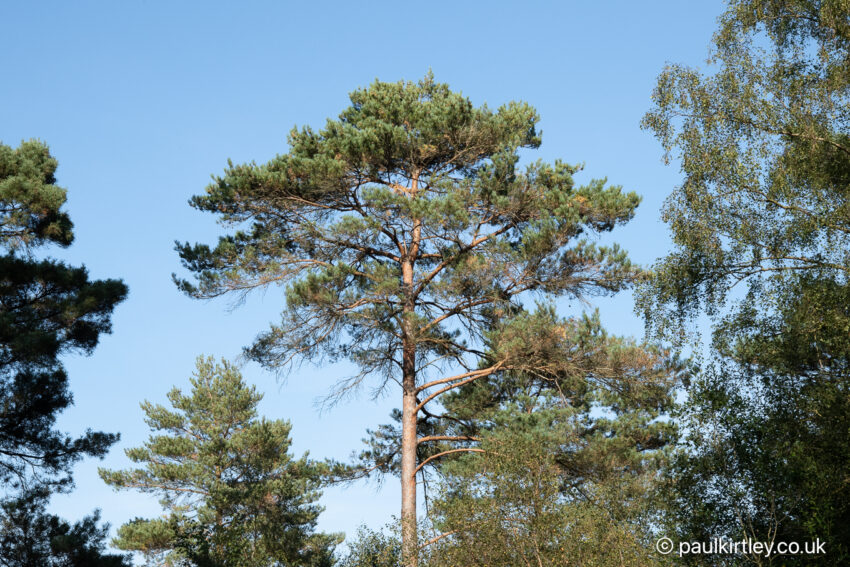
The trunks of older trees are tall, develop orange colouration higher up, and have many broken-off branches in the lower half. Many mature Scots pines develop a distinctive outline: a straight trunk, a high crown, and a more open feel compared to some other conifers. These are among the easiest clues for identification at a distance on mature trees.
Scots Pine often stands out at a distance because of the distinctive orange tones of the upper trunk, particularly when the bark catches low-angle sunlight.
As they age further, Scots pine grows in girth, and its crown becomes more rounded, possibly flat. Given suitable conditions, Scots pines can live multiple centuries, with the Woodland Trust stating that 500 years is quite possible. They typically live for 150-300 years, with mature trees of 250-300 years not being uncommon.


Scots Pine Needles
This is one of the most reliable identification features.
Scots pine needles occur in pairs (two needles per bundle, or fascicle), pointing forward along the shoot but spreading more after the first year.
The foliage is typically blue-green to green, relatively short (compared to many other pines), and often twisted.
The needles of Scots pine are commonly 5-7cm, sometimes longer on younger trees. The fascicle sheath is persistent.


Scots pine needles are thicker and more twisted than those of most other 2-needled pines, except for lodgepole pine (Pinus contorta), which is native to North America but also planted in the UK and Europe. More on differentiating these two species further down this article.
Crushed Scots pine needles have a quite sweet, resinous scent.

Scots Pine Bark
Young Scots pine tree bark is papery and orange-pink, shedding in thin scales. Later, it becomes fissured and scaly, with grey-brown lower bark, but remains orangey-red and flaky higher up.
The distinctive colouration makes bark one of the best “at a distance” features for Scots pine, especially on mature trees. A classic Scots pine often shows a striking contrast:
- Lower trunk: darker, greyer, and more deeply fissured.
- Upper trunk and larger branches: orange-brown, flaky or plated.
That orange upper bark is widely cited as a key identification cue.


Scots Pine Cones
Cones are among the most distinctive identification features of conifers. Scots pine produces separate male and female flower structures on the same tree (as is common in pines). The male flowers produce pollen. The female structures become the cones. Scots pine cone identification will help you confirm you have correctly identified the tree.

After wind pollination, the female structures develop into woody cones, often found singly or in pairs. Scots pine cones are ovoid, becoming bluntly conical, woody-scaled, and commonly around 5-8cm long, on short stalks. The cones begin green, turn brown, lose their sheen, and eventually open. Older cones may persist on the tree for some time.


Scots Pine Buds
With broadleaf trees, winter ID often revolves around buds and twigs. With evergreen conifers, buds can still be useful, but they’re usually part of a bigger picture than is available for identifying deciduous trees in winter.
When considering pines, you can use buds as supporting evidence, especially when comparing similar species, rather than as a single key identification feature.
Scots pine buds tend to be orange, pointy, with papery white scales, sometimes resinous.


Trees Commonly Confused With Scots Pine
Scots pine may be confused with other widely planted pine species that overlap its range. Equally, Scots pine has been introduced outside of its native range, where it may grow alongside native pine species of that area. Careful examination of needle length, cones, and bark colour usually ensures correct identification.
Black Pine, (Pinus nigra) vs Scots Pine
Black pines include Corsican pine, Austrian pine, and Crimean pine, which are all subspecies. These trees have darker bark and longer needles than Scots pine.


Lodgepole Pine, (Pinus contorta) vs Scots Pine
Pinus contorta, including the subspecies shore pine, and Sierra lodgepole pine, is a native if the northwest of North America, but planted more widely as a forestry tree. The needles of lodgepole pine have a similar length and twist to Scots pine, but the cones usually bear a sharp prickle on the centre of each scale (the umbo). When you look closely, the overall effect is that the lodgepole pine cone resembles a miniature pineapple, quite distinct from the cone of a Scots pine.


Red Pine, (Pinus resinosa) vs Scots Pine
Red pine is a native of Eastern North America. Scots pine introduced into red pine’s native range may require some differentiation. Red pine has a similar character and form to Scots pine, with tall trunks without branches in the lower parts, and a relatively open crown. Red pine cones are a very similar shape to Scots pine cones but tend to be a chestnut-burgundy brown colour rather than green. Red pine is also a two-needled pine but at 12–18 cm long, its needles are significantly longer than Scots pine needles.


Want To Recognise Trees Confidently in Every Season?
If you want to take your tree identification skills further, especially through different seasons, consider how recognising Scots pine fits into a broader learning journey.
Learning to identify a tree such as Scots Pine is an excellent starting point. The real satisfaction, though, comes when you begin to recognise many species and understand how their characteristics change throughout the year.
If you’d like to build that level of confidence, my Tree & Plant Identification Masterclass guides students through a structured process of learning trees and plants across the seasons. You can join the waitlist here to be notified when the next intake opens.
The Value Of Scots Pine
It’s a tree that has shaped landscapes, supported wildlife, and supplied people with useful timber and materials for a long time. In the UK, it’s also particularly meaningful as the native pine and a defining component of Caledonian pinewoods.
For wilderness living, many parts of Scots pine have proven to be valuable.
Bushcraft Uses of Scots Pine
Scots pine wood is resinous and burns fast, usually with a good amount of light. Relatively knot-free sections of straight-grained species lend themselves well to feather sticks, and splints of kindling, for which turpentine-rich lengths are particularly good. Bundles of dead needles, still attached to a (dead) twig can also be helpful as kindling or building up flames for a quick boil.
Resin-soaked deadwood, often called fatwood, makes a very effective tinder and fire starter when applied correctly. Pine knots retain resin and are preserved even in otherwise rotting trunks. These can be burned as a source of illumination.
If the wood is bone dry and not too resinous, it makes for a successful bow-drill set, too. Pine roots can be used for bindings, either directly or beaten, then separated into thread-like fibres.

Food and Medicinal Uses of Scots Pine
The needles are rich in vitamin C and, steeped, make a pleasant hot beverage. The inner bark of Scots pine has been harvested by the Sami People of northern Fennoscandia for food. The inner bark can be dried and pounded to make flour. Scots pine bark flour is one source for making bark bread.
Scots pine resin has been used topically, both on its own and mixed with other ingredients such as beeswax and animal fat, for the treatment of a range of conditions that benefit from antimicrobial or anti-inflammatory treatments. The resin has also been used to treat sore throats.
Scots pine resin has antiseptic, antifungal and anti-inflammatory properties due to the presence of pinosylvin, a natural compound produced by the tree that helps protect the wood from fungi and other microorganisms.
Pine essential oils have been used for inhalation to treat respiratory problems. Pine baths are considered the most widely used herbal baths for treating muscle aches, rheumatism, and neuralgia.
Scots Pine – A Tree Worth Knowing
Scots pine is one of the most distinctive and widely distributed trees of the northern hemisphere. Once you become familiar with its orange bark, paired needles and characteristic form, it becomes easy to recognise in the landscape.
Learning to identify Scots pine not only helps you recognise an important species in its own right, but also provides a useful foundation for recognising other conifers.
If you’re fond of Scots pine, please leave a comment below to let me and other readers know why it’s a special tree for you.
Further Reading
The following books provide useful background on tree identification, natural history and traditional plant uses relevant to the topics discussed in this article.
For readers interested in learning more about tree identification:Collins Tree Guide — Owen Johnson & David MoreA superb modern field guide to European trees and one I often recommend to students learning tree identification.Trees of Britain & Europe — Keith RushforthA detailed and authoritative reference covering a wide range of species found across Britain and the wider European landscape.Pines: Drawings and Descriptions of the Genus Pinus — Aljos FarjonA beautifully illustrated reference dedicated entirely to the genus PinusThe Handbook of Native Trees and Shrubs — Charlotte de la Bédoyère.
For natural history and cultural context:Flora Britannica — Richard MabeyA classic exploration of the cultural history and folklore surrounding Britain’s plants.The Scots Herbal: The Plant Lore of Scotland — Tess Darwin
For ethnobotany and medicinal uses of plants:Medicinal Plants in Folk Tradition: An Ethnobotany of Britain & Ireland — David E. Allen & Gabrielle HatfieldThe Medicinal Flora of Britain and Northwestern Europe — Julian BarkerMedical Botany: Plants Affecting Human Health — Walter H. Lewis & Memory P. F. Elvin-Lewis
You can find additional recommended field guides and natural history references on my resources page.
Related Material on this Website
If you enjoyed the Scots pine article above, then you’ll probably like the following selection of articles, guides and podcasts, also on this site…
Bark And Buds: How To Easily Identify 12 Common European Deciduous Trees In Winter
Know Your Ash From Your Elbow: How To Identify An Ash Tree
European Alternatives to Balsam Fir for Medicinal Purposes
A Winter Camping Trip in the Northern Forest
Wild Wanderings 9 – Gottröra, Sweden
Wild Wanderings 12 – Loch Morlich: A Gem of the Cairngorms National Park
PK Podcast 35: Anna Lewington on Adventures in Ethnobotany and the Bounty of Birches
8 thoughts on “How to Identify Scots Pine: Wild, Wonderful & Widespread”
Extensive read Paul, gives a enormous portion of information.
Maybe a bit too much for some?
Thanks for that!
Would be great to have a book of your hand regarding trees and its uses in relations to Bushcraft
Hi Marc,
Thanks for your comments. I’m glad you liked this material. It may be too much for some but there are already plenty of superficial resources out there, both online and in print. I prefer to make material that is more substantial and useful to those who want to go deeper. I would very much like to make a book in this direction. Maybe one day I can find a publisher who will take it! I know we will have at least one customer 🙂
Warm regards,
Paul
Fantastic and exhausting portrait of the tree. Also a great recap of the materials from Plant ID course. Thank you Paul for pulling this together
Hey Pschemek, it’s good to hear from you.
Thanks for your comment and I am glad you found this a useful recap of the Tree & Plant ID materials around Pinus sylvestris.
Warm regards,
Paul
Very interesting write up, even for someone who lives in the southern hemisphere.
We have lots of pine plantations around, it will be interesting to see if I can tell the difference between the types listed.
Hi Matthew, I’m glad you found this write up interesting and I appreciate you feedback. Let me know how you get on with identifying the pines you have planted down your way.
All the best,
Paul
A hugely valuable and extensive article. Many thanks for the time and effort. It is always useful to have clarity when identifying this wonderful and useful conifer.
One of my favourite trees. The colour, the scent, the shape and the fatwood when you can get it!
Great information, thank you.